Thursday, 18 December 2014

The Lion with no Pride


The Lion with no Pride


Very few people can have endured the charge of a bull elephant at night while in pitch darkness, seated in a low, open vehicle in the midst of a pride of a dozen lions. I have. And it can be great fun if you’re with the right people! Here’s the story.  
    
 A decade ago I undertook the evaluation of nature guides for the renowned conservation and tourist hosting company CCAfrica. The company is now known as ‘& Beyond’. The two main nature resources concerned were Phinda in KwaZulu-Natal and Londolozi in Mpumalanga.

 The project was a pleasure to undertake, and a great experience. Each guide I assessed had already completed a tough training programme headed by two young professional ranger-conservationists, Graeme Vercueil and Allister Kilpin. The guides skills and knowledge had then been refined during an extended period of practical implementation with customers. I accompanied many of these excursions with customers, since they gave me an opportunity to see how the guides performed in managing the cycle of routine drives.

 Day tours on an open vehicle were exceptional experiences, but the night drives presented a special treat. With nocturnal creatures going about their business, there was a great deal of activity. One night drive proved especially memorable.

 
Start of the dusk patrol
 
A young guide I'll refer to as Glen drove the open vehicle. An African guide named Vincent accompanied him. In daylight drives in open country, Vincent would seat himself on a chair at the front of the vehicle; but on night drives, he would be inside the vehicle on the left seat for safety.
 
A .375 Holland and Holland Magnum rifle, loading cartridges the length of a man’s finger, lay in front of the two on a metal cradle mounted on the dashboard. Sound strategies were in place to ensure that the guide never used the rifle except in extreme circumstances. To kill a wild creature would signify the most abysmal failure.
 
“The lions were seen in the northern sector this morning before lunch, to the west of the marshlands,” Glen told me on the afternoon before the drive. “They seem to have slept off a big meal during the morning, and might eat again this afternoon. They took a zebra, I think.”

“How many lions?”

“There are four adults, one a mature male, and seven half-grown cubs.”

“Do you think they’ll hunt again tonight?”

“Probably not. I think they’ll finish the zebra and then sleep it all off.”
 
We set off from the beautiful Forest Lodge with six guests. I sat behind the African guide. The dark olive-green vehicle carried a supply of rugs because it could be cold when seated on the raised seats with no roof, and a windscreen that protruded just above head height. Although we would travel slowly, the air could be chilly, and Glen advised the guests to dress warmly to fend off the cold, night autumn air. Most brought jerseys or jackets, as well as balaclavas and even gloves.
 
We ventured forth on a night that began as black as ink. Our powerful torch, driven by the vehicle engine, cast a sharp, penetrating glare of light into the darkness. To avoid damaging the delicate tapetum cells found at the rear of the eyes of most predators and certain other crepucscular or nocturnal animals, we had covered the raw, destructive white bulb and lens with a red filter before we left.
 
As we progressed, a crescent–shaped sliver of moon appeared low on the eastern horizon and climbed imperceptibly in a long arc through the sky. The darkness gradually gave way to a blush of silvery moonlight that bathed the landscape and cast dark shadows across the grass.
 
We were fortunate in the many wild creatures seen; a number of impala whose eyes reflected brightly in the darkness; a genet, and even a bat hanging head-down from an overhead branch. All had the glare reflected away from them as soon as contact was made, to ensure protection of the vulnerable tapetum cells in their eyes.
 
Eventually the radio crackled into life, and a report came in from a ranger who had led an afternoon excursion to the area. He said that instead of hunting again the pride had fed that afternoon, quite late. It was resting in the proximity of a sand forest lying two kilometres west of a small dam that adjoined the marshlands.

 We wound our way carefully towards the forest, and in due course slowed to a crawl because we were near the pride. To the left of the track lay the seven youngsters, sprawled on the ground amidst short grass, and all fast asleep. As we drew closer, one or two ears twitched, and an occasional sleepy head rose with effort and then sank again.
 
“Don’t stand up or reach out. Just stay seated, and the less talking now or distracting noises, the better. We don’t need silence, just no hubbub.”
 
To the uninitiated, it might seem strange that lions are not disturbed by the presence of a vehicle, and the presence of humans on it, unprotected by glass windows and a roof. Lions seem, however to smell only the petrol, oil and other lubricants, and tend to globalise the vehicle and the living creatures on it into a gestalt; that is, a single large metal object devoid of living parts. It is of course not reassuring when a lioness walks past your seat two metres away and slightly beneath you, flattens her ears and stares straight into your eyes for a time as if you were prey.

 “Follow Vincent’s light,” said Glen. “He’ll pick out the youngsters for you.”
 
There was palpable excitement from the tourists as we wended our way through the sleeping, half-grown, or three-quarter grown youngsters. The largest amongst them were quite capable of disembowelling a human if provoked to do so. Soon gently snoring lions, lying in a variety of poses, sleeping off their ample meal of zebra, surrounded us. Vincent went about his duties quietly and efficiently, and Glen picked a way through the carnivores.
 
After moving forward a further fifty metres, we came to where the adults were sleeping. The male was a magnificent specimen of four years of age, with a dark mane. Full grown, weighed about two hundred and twenty kilograms, and his distended stomach showed that he had fed well. Two young lionesses were with him, weighing perhaps a hundred and thirty kilograms each. An older female lay a few metres further on. All were fast asleep when we arrived, and barely moved as the engine purred towards them. All had fed well. We studied them in silence, broken only by a whispered remark or metallic click as someone adjusted the light or a camera. The scene was a perfect picture of calm.

 Suddenly from the left rear of the truck, from perhaps a hundred metres off, came a shrill squeal of surprize, followed by low grunts and the rustling of bushes.
 
“Elephant,” said Glen. “It’s blundered into the cubs, and doesn’t sound too pleased.”
 
The shrieks rose to a crescendo, and we tracked the large herbivore moving forward in the darkness on our left flank. Shortly thereafter, the first of the young lions arrives, bewildered and trotting towards the adults for protection. They let out little growls and grunts as they came. Quite soon, all seven were around the vehicle, prowling around us, bewildered and bemused as they tried to make out what to do.
 
Although we could not see the elephant, it was clear that it had been alarmed at its encounter and was now enraged and irascible. It was moving forward on our flank, occasionally dislodging dry boughs or even snapping saplings as it barged its way through the scattered shrubs and trees.
 
Now also alarmed, the four adult lions rose to their feet. The male began to roar, an ear splitting volume of sound from the proximity of a few metres. Facing the location of the elephant, he raised his head and with flanks heaving, began a series of guttural roars that began as a deep aarouff! aarrouff! aarrouff! and ended in a string of panting grunts. Not to be outdone, the two younger females joined in, and soon we were audience to a chorus of thunderous challenges ringing through the African bush. Confident in their parents’ expertise, the youngsters hung close to them, which implied their continuing to mill around the open vehicle. The rugs and anoraks each of the passengers wore offered little protection if one of the lions had decided to sample any of the seated spectators.
 
“Don’t worry, they’ve all eaten,” Glen offered as a means of reassurance.
 
Suddenly, I could hear the squeals and trumpets of the elephant no longer receding. The great beast seemed to have stopped perhaps the length of a rugby field away in the darkness. There was renewed energy from his giant lungs as he let out a particularly shrill shriek, and then the sounds of branches and dry vegetation snapping. It came ever closer, and the truth became clear. We were in the path of a charging elephant…and from the ease with which it snapped off or cast aside trunks and branches as it came, it seemed to be a mature specimen.
 
The bravado of the lions evaporated. Frankly said, they panicked. The entire pride fled. One adult female found the bonnet of the vehicle obstructing her. She sprang clear onto it and then leapt down the other side of the vehicle. The male and two females scampered under the rear of the vehicle. One glanced up at me and its eyes met mine for a moment. There was no hostility or predatory intent, but only fleeting anxiety and a desire to be gone.
 
“Great,” I said to Glen. “Your big male gets us into trouble, and then they run. We’re left to handle the mess. Where’s his pride?”
 
We were still facing the awesome, crashing power of the charge. The elephant was now very near.

 “Vincent, take the red filter off,” Glen instructed the assistant guide calmly as he started the vehicle engine.
 
The .375 Holland and Holland Magnum remained resting in its cradle. One could now see the swaying of vegetation twenty metres off and hear sharp cracks as small trees went down. Then a sapling the width of one’s calf shattered at the edge of vision and the shape of a huge bull elephant exploded into our circle of light.
 
He stopped abruptly no more than the length of the vehicle from us, furious and vengeful as Vincent directed the light up at him with the filter off. His big domed head loomed over a flailing trunk, and then, bemused and bewildered by the glare, he sought the objects of his displeasure. Trumpeting and furious, he pacing up and down but did not advance. The light was held steadily as the engine was kept turning. The .375 still lay in its cradle.
 
After what seemed an eternity, yet was but a moment, the big bull swung away. As rapidly as it had come, it disappeared remarkably silently like a wraith into the enveloping darkness.
 
“Yes,” said the young ranger. “Our lions got us into this, and then left us to handle the mess. As you say, ‘where’s their pride?’”

A whale of a shark


A whale of a shark

Some years ago after qualifying to train marine and coastal tourist guides, I returned to angling which I had done as a youngster, usually on a ‘catch and release’ basis. I joined the Durban Paddleski Club and for a decade fished from paddle skis off Vetch’s Pier north of the harbour entrance of Durban.


Fishermen on the Durban Paddleski Club beach
 

I owned a ski made by a veteran of the sport, Dennis Glazer. His skis were quite robust and heavy. They were eight feet (about 2.4 metres) in length, and four feet (1.22 metres) in width. A Glazer ski was very stable under conventional use. Unfortunately, the use to which I seemed to subject them was not ‘conventional’.

The sandy beaches opposite our clubhouse near the North Pier of the harbour entrance made launching easier than elsewhere on the coast, and the waves were subdued if a southeaster was running. When the north-easterly blew, however, launching could be difficult because the wave height increased.

As a new member, I gained fame for some of the most spectacular launches and landings seen in those parts. I seemed to have the capacity to rear the front of the boat up vertically, even in the most placid of seas, and occasionally did it with such perfection that the boat would rear heavenwards and capsize backwards to roars of mirth from the shore. My landings were a voyeur’s dream. I could dig the nose in with impunity as I slid the craft down an incoming wave, sending the ski veering to the left or right before tumbling it over in the waves. Members of the club used to line the verandah of the clubhouse in anticipation of a good performance. It gave me deep satisfaction bringing joy to so many people.

For a year or so, I cut my teeth (and hands) on a friend’s ski; and made a significant contribution to the chumming process by vomiting regularly on the short foredeck of his craft. First would be a mild queasiness, then a bout of sweating that foretold something more to come. I would then go on hands and knees to relieve myself of breakfast. No Roman senator of ancient times could do it better. My colleague eventually dispensed with chumming, since I could do the job for him in any mildly restive sea.

One morning my wife Memory and I ventured out in a southwester to test the boat. With a great deal to remember on our maiden voyage, I forgot to put the plug in. We sped out, sinking imperceptibly. The slight ripples that the wind brought steadily turned to waves that began to breaking and foaming on the surface of the sea. Memory was perched on a slippery cushion over the mid-hatch and I sat on the stern.

Soon wet and even more slippery, the cushion began to skid and my wife slid to her left, clean off the boat. As she went, her clutching hands pulled strongly on the hatch cover, almost turning the boat over. Finding us in a state close to capsize, I did a backwards roll over the rear and was soon in the water alongside the boat. Memory grasped her drifting paddle, which I had secured to the boat, and being a good swimmer, had no trouble staying afloat. I did ‘doggy paddle’ at the back. Soon an engine powered ski-boat arrived.

“Having a bit of bother, then?” asked the skipper in a rather condescending tone.

“Not really,” I countered. “It’s our new fishing technique. We usually go a few hundred metres offshore. My wife then goes in to the port side and herds the fish towards me. As they come around the stern I bash them with the paddle.”

“It could take quite a long time before you get anything,” the skipper replied. “Your method hasn’t had much success for a couple of years. We’d better get you both in.”

My wife managed to scramble onto our small craft, and then clambered onto the ski boat. I accepted a tow gladly. My small craft was by now sinking and the prow was high in the air with the stern more or less awash. I was released a hundred metres from shore and my wife landed in the small, calm surf.

I then had to face a daunting paddle, with the breeze now blowing directly offshore into my face. The prow was well up, and the stern was sinking yet further. To say paddling was a laborious affair is to understate the case. It was almost impossible. And, all the time, out of the corner of my eye, I could see the club members literally rolling on the ground in mirth. I swore vengeance.

After an eternity, I made it in a state of exhaustion. After staggering up the beach, I approached the clubhouse. Memory was waiting there in the midst of a kindly and solicitous group of members. Something I can only describe as ribald good humour greeted me.

“Sending your wife in to catch them with her hands? It’s scandalous!” someone exclaimed.

“Have you tried fishing rods and bait?” someone else asked.

“Bet you won’t forget the cork again,” said another.

They were a tough lot. My revenge came a year later.

 On the morning of my triumph, I paddled out early at sunrise with a friend on another paddle ski. We crossed Vetch’s pier, a line of submerged rocks four hundred metres long, and I had paused to prepare a heavy rod for the bottom fishing I wanted to do inside a line of sandstone known as Limestone Reef. This barrier of rock ran parallel with the coast and was perhaps four hundred metres from shore. It had water four metres deep behind it, and was relatively sheltered because the rocks tended to break any surge coming in from the northeast. On the other hand, at certain times and in certain conditions, waves could rise unexpectedly and crash over the reef. Many boats had capsized on the reef. Only a moments neglect or inattention could cause a mishap.

I uncoiled a short length of line, and was ready to bait it when I made out the dark shapes of two huge fins a hundred metres further out in deeper water. I was baffled because the fins were enormous. The one that was furthest from me was perhaps a metre and a half high, and the fin closer to me was about a metre in length. We had no fish matching the size of the fins, and I wondered if a pair of thresher sharks had wandered into our regional waters. That seemed impossible. My curiosity now thoroughly aroused, I decided to investigate. My sensible companion decided to stay floating directly over Vetch’s pier, where he would have a metre of water under his boat, a sufficient obstruction for any large fish.

Manoeuvring my ski, I managed to position myself in the path of the two fish, and in due course, they were swimming directly at my boat. When the first of the fins was still some metres off, I looked down and was amazed to see a giant creature, considerably wider than my 1.22- metre wide ski, passing underneath the paddle ski.

The surface seemed dull blue-green with a scattering of lighter, serried flecks. Simultaneously there was a sharp tug on my left-hand rod and it whipped over, dipping the left gunwale under the water. I nearly capsized. The sharp twang I heard showed that my small 2/0 hook, dangling in the water since I abandoned the baiting activity, had snagged in the creature. The line had parted just below the bait-line swivel, resulting in the loss of about a half-metre of line. With the severing of the cord, my paddle ski righted itself with a surge of water and I regained balance.

The first fin was approaching, sinking in the dark water as it came. Just when a collision seemed imminent, the fin submerged fully and passed under the boat. The second fin approached, still well above the water, but to my relief it also sank. I realised that what had appeared to be two fish was a single giant creature…and then it dawned on me. It was a whale shark, rhincodon typhus. The enormous beast had surged under my paddle ski, catching the small hook as it went, and it’s dorsal and then caudal fin had both sunk beneath the craft. I was grateful that it hadn’t seen fit to thrash or even slightly flex its tail. The turmoil could have capsized and perhaps sunk the boat.

The giant turned as it sensed shallower water, and made a wide arc away from the surf line. It was still well inside the nets, which lie perhaps four hundred metres offshore in ten metres of water. If the giant snagged on them, or became entangled, the ensnaring could cause its death as well as damage to the nets. It would be yet another great creature sacrificed for the sake of individual wealth. The pale light of dawn was by now strengthening and penetrating the surface with a silvery-green glow, and it was possible for spotters on shore to track the animal’s progress.

Uncannily, it avoided the nets for some time, and then I heard the reassuring chug of the Sharks Board craft. By judicious manoeuvring the crew managed to herd the great fish to an opening in the nets and soon it was moving out to sea where it disappeared. Had the nets entangled the beast, it would no doubt have drowned; and another great creature would have died. When I spoke to them later, they estimated the length of the fish at fourteen metres; that is, about forty-six feet. The width, as far as I could reckon it, was a little more than about one and a half metres; that is, about five and a half feet.

After years of catches that were a small as my bait, doing spectacular capsizes and holding the chumming record, there was a certain grim satisfaction in holding the record for the biggest ‘un that got away. Even the full expanse of my arms could not do justice to it.

A Stone-Age Creation Myth


A Stone-Age Creation Myth


Have you ever wondered what life must have been like during the stone-age, when people hunted with spears and arrows tipped with a bit of flint or bone? Well, if you were living in Natal a hundred and fifty years ago, you’d have found out.
 
This story is taken from my book ‘Child of the Dragon Mountains’, dealing with the lives of a San (Bushman) family living during the 1800s in the Drakensberg Mountains of Natal.  The San central to the story is named !Bo.
 
The exclamation mark in the name can be produced as an explosive pop! if you extend your lips to form a short funnel, then withdraw your tongue sharply from behind your front teeth. On balance, it’s better to warn people before you experiment with the name at a formal function or the dinner table.
 
As a young man, with several shamans in the clan from whom he could learn, !Bo had accumulated an impressive store of knowledge and some wisdom about the role of a shaman. Two older women of the clan were active in the shamanic rituals, and in many cases excelled the men in making rain and the laying on of healing hands.

 When !Bo confided to his mother his interest in learning more about the craft, Xama suggested he be apprenticed to one of the women. Most successful and experienced was the wizened, elderly matriarch named Mikau who had explained so clearly years before how Cagn had created the eland. Her husband and children had drowned many years before during a flash flood, when she was a young woman.
 
She had been inconsolable, yet never spoke of her grief. Perhaps to comfort herself and occupy her time productively, Mikau had turned her considerable talents to refining her shamanic skills. Everyone throughout the region knew the old woman. During the more settled times of her youth, the amaZizi had often asked her in years of drought to bring the soft, soaking she-rain to their small maize plots.

 Although Mikau was old and frail, and mumbled when she spoke, she made very good sense when she did. !Bo was wary of her at first, because he saw her watching his furtive attempts at art. He resolved to ask her courteously for guidance.

 “Mother Mikau,” he asked one morning when out of earshot of the others, “will you please teach me how to make rain, and how to heal?”
 
“You are a very forward young man,” Mikau replied. “You dare to ask me?”
 
Then she smiled, and said that she was willing to tutor !Bo because, as she put it:

“You are already a hunter known in these parts, but so are many other men, and even one or two women. That brings us food. It is important, but it is not everything.”
 
She paused, and chose her words with care.

“Your other talent is more crucial to our clan. It is this; you are becoming a great artist. Now that is really important.”

“Why so, Mother?” asked !Bo, guessing at the reply.

“It is because you have the ability to represent in your painting the mind of the trance experience, and the power that God can bring to us. And your first lesson is to not call me ‘Mother’, as if I was some old hag.”

She paused, and then went on. “Now think on what I have said.”

As she got up to busy herself with preparing the evening meal, she said:

“Yes, I will tutor you. But, it is only because you are an artist. Also, I shall do it because you have shown much determination. Otherwise I would not waste my time with you.”

The arrangement met with general approval.
 
Dying eland and shamans
 
A few days later, !Bo sought her out again, and they sat some distance from the others. Would she reaffirm what //Zamkau had said? The old woman did not disappoint him.

“But with respect, mother Mikau … er, Mikau, why is painting important in becoming a shaman?”

 “Because only if you paint what you experience in trance will your paintings have potency and continue to help you with the work of healing and bringing rain and fighting the evil spirits. They hold much potency in themselves. Painting without potency is just the making of images, or a record of things seen; and not experienced in trance. There is potency and power in the dance, and in paint.”

“That is what the great artist //Zamkau told me.”

“That is why //Zamkau is known as the greatest artist of this region.”

“He is indeed. And he spoke of Cagn.”

 
“Cagn was the first being, as I have told you before. His wife is Coti. She came later, with those who brought the sun. Only the initiated men of the dance can explain it all. Those who do are the proper shamans.”

“Why is Cagn important?”

“Cagn made all things; the sun and moon and stars and wind and rain, and mountains and animals. Only he made them, yet he has shared them. They belong to us all.”

“So he is the most powerful?”
 
“Yes. Cagn had two sons, Cogaz and Grewi. There are three great chiefs, Cagn, Cogaz and Quanciqutshaa, but only Cagn is the Creator who gives orders. He is by far the most powerful of the three.”

“Cagn made all things and we pray to him. At first, he was very good, but even he became spoilt by fighting many battles and overcoming many problems. We pray by imploring; ‘O Cagn, are we not your children? Did you not create us? Feel our hunger!’”

 “What does Cagn do?”

“He gives with both hands full.”

“What of the eland?”

“As I have told you before, Cagn knows where his eland are, and they know where Cagn is. There are many eland in his great place. He gives some, yet he loves them.”

 “So he is supreme?”

“Yes, there is a supreme Creator,” Mikau told !Bo, “in charge of all life, and responsible for the rising of the sun each day, and for the rain. He created the sky and the mountains, from which water comes. It gives life, and falls from the sky and runs down from the mountains, but also seeps up from the rocks. The Creator rules the spirit world that is in the sky and even in the mountains, and within the rocks of our shelters. He has a family to help him in all he does, but they are sometimes disruptive beings with their own view of things. Sometimes they help him, and sometimes they have to be disciplined.”
 
“But my father and //Zamkau have spoken of evil spirits.”

“Yes, there are also some lesser spirits, and they bring illness and death since they rule the underworld. But you must never fear death, because you will die many times in the trance, but if you comport yourself well you will surely return and influence the living … and so you are not dead.”

“Is that why some of the ironworkers and even our own people throw a pebble down? Because of spirits?”

 “Indeed, it is because of the evil spirits that can haunt a place that we sometimes throw a pebble down at the path side. We do it to reach the good spirits in the vicinity and so implore them to keep the evil ogres away. I know that travellers do that often beyond the great river … the uThukela as the Zulus call it. It is because many man-eaters live in those parts; and if you go through their lands, you’d better ask the spirits for protection before you venture there. And, when we bury a person, the spirit remains. It lives above the grave. You can seek their protection as well.”

“And who do I follow at the dance?”
 
Like //Zamkau before her, Mikau sighed. It was a long, deep, condescending sigh.

“You follow no one,” she said patiently. “That was when you were a novice. You are a man now. There is not much that I can teach you. The spirits will do that. Give yourself to them. Reach them through the dance. Climb to the sky, and penetrate the rocks.”
 
“You are a teacher with much wisdom.”

“You will learn to be a shaman by dancing,” she continued, slowly and almost whispering. “This means dancing in the way that the spirits direct. The great Creator created all things. He loves his creatures. However, of them all, he favoured the eland. He has given it great potency. The eland feeds us and provides our needs, but it must die to do so. We take the eland, and in turn, we who are shamans must die the death of the eland to atone for our killing of it. In turn, we will get great potency. So, dance until you are exhausted, and live the death of an eland. Your nose will bleed, as the nose of the eland does. Smell the blood so that it will help you to achieve potency. Potency will rise from deep within you. You will learn to master your rising potency. It is dangerous and terrifying.”

 “But many do not become shamans. My father told me so.”

“Your father was correct; many who try do not become shamans. Remember his advice. Only if you are willing to heal others will you become a shaman. You must wish to heal people before you can climb the rope.”

Exhausted by the long ramble, Mikau sighed and then lapsed into silence and sat brooding for a while.

“Thank you Mikau. You are a great teacher.”

“And one day you will be a great shaman,” the old woman mumbled, “because you want to learn.”
 
!Bo now gave himself more completely to the dance. He liked the freedom that Mikau’s tutoring gave him, and he saw increasingly the important role in the clan of women such as she was.

“It is they who sit at the centre of things, directing potency through their songs and the rhythm of their clapping,” he told himself.
 
A few days later, he approached Mikau again.

“You began to speak of the trance dance,” he said. “Please tell me more.”

“Cagn it was who provided the potency song to accompany the trance dance. The dancers die, but Cagn raises them to life again. It is a circular dance and as you well know, the dancer-shamans perform all night for maximum potency. Many dancers fall down, maddened and exhausted, as you have seen. Blood sometimes comes from their noses, as it would from a dying eland. The shamans sometimes take snuff that contains charm medicines with powder from burnt snake venom in it.”

“Does the snake venom make their noses bleed?”

“I do not know. No one knows.”

“And how does one heal?”

“In the healing dance, the shamans will dance around the sick person, and hold him up, propped under the armpits. They will press their hands to where the pain is, and sometimes the patient will cough up the evil spirit. You will learn by watching closely, and then doing it.”
 
On the day of a major kill some days later, !Bo extended his experience of the dance greatly. The clan was assembled, together with several kinsmen who had shared in the meat of the eland, and a dozen dancers stepped into the deep rut that would guide their dance.

“It is a great time for the dance,” commented old Mikau. She looked tired yet strangely ecstatic. “They say the bees of Coti are swarming down the Umlambonja, and that always signifies great potency. It is a time of life, and a time of death. It is perhaps my time.
 
The women seated themselves in the centre of the circle with two ill persons amongst them. They began singing and clapping to attract the spirit animals embodied in the paintings on the rock walls of the shelter, now reflected in the firelight.

 The dance began with a slow, rhythmic, plodding shuffle. Slowly the tempo rose as the dancers moved, first clockwise and then anti-clockwise. Since they were targets for the malevolent forces of the darkness outside the cave, each dancer carried a flywhisk of jackal tail with which they flicked away the arrows of sickness and disaster that the demons of the dark shot at them.

 After some hours of dancing, several of the dancers bent forward in increasing pain. It was a pain that welled up from the stomach; so severe that some dancers used sticks to support them or symbolise the staggering legs of a wounded creature. It was the agony of an antelope driven to exhaustion by the loss of blood, by poison, and by their exertions to escape during the tracking phase of a hunt.
 
!Bo found himself in a state of near-collapse, and could sense the presence of blood welling up in his nasal cavities with the exertion done in the thin air of the mountains. Two of the older men were also bleeding freely, and one collapsed writhing and shrieking. He staggered out of the circle, supported by two women who prevented him from collapsing onto protruding rocks, and then sank to the ground to sleep’

 !Bo had several times glimpsed luminous, fleeting shapes during previous dances, but on this occasion, he experienced an explosion of geometric shapes he did not understand. He felt himself sucked into a tunnel or vortex of swirling images. Pulsating zigzags, grids, clouds of dots, curves, and webs assailed his senses. There was a bright light at the end of the vortex.

 Looking for further inspiration, he caught a flash of the eland imagery painted on the cave walls, and in his mind transformed into an eland. His hands and feet became hooves and a great heavy dewlap developed beneath his chin. He staggered as an eland would stagger when expiring, and stood trembling with blood pouring from his nose. Finally, a rope ladder or perhaps a bridge appeared as !Bo transformed into a leopard capable of scaling it. He then encountered a sinuous line, along which he bounded in huge leaps.
 
He could feel the potency boiling up from his stomach to erupt from the top of his head. His very breath became an animal that carried him forward with amazing speed. He travelled like the wind, entering a large underground hole and penetrating the rock face as he entered the spirit world. At this stage !Bo believed he had made contact with the Creator, although he could not explain later the nature of that being; nor could he explain the vivid image of Mikau that he saw.

 !Bo staggered and fell down hard outside the dance circle; as the last to do so. He lay there entranced, cataleptic, and hyperventilating before losing consciousness and then falling into a deep sleep.

 “We thought you would not wake up.” The voice was /Toma’s. !Bo could see his father’s anxious face, with his mother peering over his shoulder. “You must indeed have travelled…”

“I have seen great things,” !Bo said simply. “Mikau was there.”

“Most of the others woke yesterday morning and gave their healing. We could not wait for you.”
 
“How long have I been asleep?”

“This is the second day. The other family have waited. You, my son, are surely a great shaman. Do not disappoint the families. Do not disappoint Mikau.”

“Where is she,” he asked. “Was she pleased with the dance?”

/Toma and Xama looked at each other. Neither spoke.

/Toma took !Bo gently by the wrist.

“Old Mikau died during the dance, but woke for a few moments before passing on. She spoke of you before she died. She is with the spirits.”

 !Bo found no answer and sat in silence for a time. He walked a short distance from the cave and sat apart on a rock, needing to be alone with his thoughts.
 
The families were then assembled, and !Bo spoke of his seeing visions of strange shapes twisting and whirling. He spoke of bright lights and long ladders reaching to the sky. He spoke of travelling like the wind as a leopard, and his transformation to become the eland. He also told of how he had died just as the eland dies, and spoke of his communion with the Creator after he had penetrated the veil of rock that hid the spirit world from view. He had pleaded for the souls of the sick, he said, and had seen their sickness expelled through the back of their necks.
 
The two San who had been sick recovered steadily. Within a week, they were both walking again. They came to thank him.

“I do not understand it,” he said simply. “But it is Mikau who you should thank. She gave me guidance.”

 !Bo found a great release in the dance. It was something that he could engage in without self-consciousness or embarrassment, and he used the freedom it gave him to extend his understanding of the wild creatures that shared the world with him and his community.
 
In lighter moments, to teach the children, !Bo practised the mimicry of animal behaviour. The family would gather around the fire on a pleasant evening and !Bo would mimic one or other animal.
 
The eland was always popular because they were so important in the lives of the San. !Bo would vary his performance, perhaps showing the threat display of a large bull intent on intimidating a rival. This involved lifting the muzzle with ears raised, shaking the head, and perhaps stabbing with the horns if the shaking display produced no result. Finally, there might be a determined head-down charge with ears back; an action that would send the watching children into mixed screams of terror and joy. He would then show the submissive gesture of head shaking with the ears and head lowered, as a competitor expressed subservience to the dominant bull after a charge.
 
The leopard was another favourite, moving with sinuous grace and marking its territory with urine and faeces, clawing the bark of trees and vocalising in a series of threatening rasps. The contented purr transformed in a moment into a growl, spit and snarl of anger that showed response to a threat. !Bo would also show a low-slung stealthy stalk with moments of freezing if the prey looks up, to a final rapid charge, leap, grasp and bite to the neck.
 
More humorous was the mimicry of a family of dassies (hyrax), with their wide repertoire of calls, male-dominance threats, and submissive behaviours. It was the baboons, however, that would get the children shrieking with laughter. The children loved the displays of foraging, showing submission, standing guard, and giving threat displays that showed the remarkably long fangs; but most enjoyed of all were the tantrums thrown by a baby baboon when its mother refuses to give it a ride on her back.


King Shaka of the Zulus


King Shaka of the Zulus
 

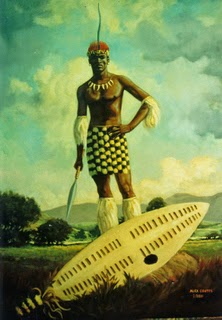
Look closely at the accompanying painting of King Shaka ka Senzangakhona, twelfth king of the Zulu nation. The original work was painted several years ago by the author of this blog, in oils.

 
King Shaka of the Zulus

It is a truthful interpretation, based on forty years of research including the historical testimony of the trader and friend of the king Henry Francis Fynn. It is arguably the most accurate representation of the Zulu king anywhere in the world. The image is offered as a standard for other portrayals. It provides the cover for the historical novel ‘Shaka, the story of a Zulu king’, found elsewhere on the website that supports this blog.
 
The Zulu king was known for his stature and magnificent physical presence. He projected dignity and a sense of command, was powerful in build and indeed displayed ‘remarkable athletic ability’ according to the testimony of Isaacs, one of the traders of his time. 
 
Since Shaka’s death in 1828, many artists have tried to portray him in paintings or sculpture. From the often bizarre works seen, one concludes it to be a difficult task.

The build should be even more muscular and athletic than most of the earlier attempts, showing a man whose tall stature was instantly recognizable in a crowd.  The posture should be alert, coiled, prepared for action; for he was a man attuned to the nuances of the times and ready for any challenge.

Anyone wishing to do justice to the Zulu king through medium of sculpture would require a figure at least three metres in height to give the necessary weight to his presence, while not being banal for its reliance on massive proportions alone.
 
King Shaka was a man of considerable intelligence who planned complex campaigns with great insight, undertook the training of his irresistible fighting forces with great skill and managed the integration of numerous lesser tribes and clans into the growing Zulu nation.

It was a task requiring considerable gathering and processing of information, logical, rational, critical and creative thinking, and an acute ability to understand how social systems work.  Engineering the stabbing spear, designing the battle-formation for attack modeled on the olden-time hunting tactics of a Zulu family, implementation of complex social and legal systems, and leadership of the First Fruits and other ceremonies showed much creative flair.

The manner in which he overcame the intrigues of rebellious sangomas and the deception with which he enticed and lured into ambush several invading Ndwandwe hordes from the northern lands around the Pongola river also reveal his ability to think divergently. His was a considerable intellect.
 
There were notable examples of honourable conduct on the king’s part, admiration for bravery and the discharge of duty, forgiveness for those who spoke the truth boldly, and compassion for the poorest amongst the nation.  Despite his gravitas, there were glimpses of humour at times. With the later politicization of the king’s record, those who wished to discredit him neatly omitted these attributes while magnifying the harsher side of a harsh reality. 

Yet even the most brutal of the recorded methods of punishment used by the Zulus of the time were no worse than what was done at the same time in apparently ‘civilized’ nations such as England and France. There, terrible procedures of hanging, drawing and quartering had been used for more than five hundred years. In current times, savage and ferocious forms of execution still persist in many parts of the world.

Any statue must reflect a penetrating intelligence and the dignity befitting a man of massive presence and gravitas.  He need not be particularly handsome, since there is no clear record of his features, yet the sculptor must shy away from portrayals that do not get the features anatomically in proportion. The face must be absolutely right, and it must be strong.

For decoration and a display of power, King Shaka had a band of strung lion’s teeth encircling his neck.  In less formal attire he wore tassels and even genet skin. He sported a loin covering of assorted samango monkey, genet and other tails (the isinene) of a length befitting a senior man, and wore a soft antelope-skin covering (ubeshu) hanging to behind his knees in his mature years.

His full headdress was magnificent, being usually bedecked with an apron of red purple-crested lourie (touraco) feathers inserted in a thick band of leopard skin or brown otter pelt, all surmounted by a sixty centimetre long blue crane feather at the front. Around each upper arm and lower leg was a tassel made of long bleached hair derived from the extremities of cattle tails.

Plugs of shiny yellow cane were inserted in his ear lobes. The clash and contrast of the primary colours; blue (the crane feather), red (lourie feathers) and yellow (cane for the ear decorations) was impressive.

His weapons consisted of a great white shield taller than most men, made of double-layered cattle hide with a small black patch the size of the open human hand slightly offset at the center. It was a blemish to show that even the king did not regard himself as perfect.  The shield must be that engineered by the Zulu king, and not the smaller version that crept in during ensuing years under Kings Dingane, Mpande and Cetshwayo.

His spear was the iklwa! stabbing spear, a metre long with a massive, razor-sharp hammered-iron blade. The wood was flared at the lower extremity so that it would be secure in the king’s grasp during battle. It must be displayed in the right hand, held low since the attacking thrust was upwards under the ribcage, and not a futile overhand jab. 

The image should preferably show the King in full battle dress, something like the miniature displayed in the Old Courthouse Museum in Durban.  He might be leaning slightly forward, or at least be balanced to show a powerful, coiled posture from which action will erupt.
 
Considering the emotive hold the image has over the Zulu nation of 9 million people, it is advisable to get the image correct. Our Zulus don’t take kindly to any slight directed to their kingly lineage.


How to Solve Problems


How to Solve Problems


Would you like to be a problem-solving whizz-kid? So would we all! Although whizz-kid status might be some way off, it is possible to improve your problem-solving capabilities greatly by simply studying and following a few guidelines or ‘heuristics’.
 
Most people have no doubt often thought about how to solve specific problems as they arise, but it seems that few have ever thought seriously about the principles, processes and methods they might use in solving all or most of the problems they have to tackle.

You don't need a Ph.D. to think brilliantly 
 
 Yet such principles and processes do exist, and they are worth examining because if you get them right, they can empower you. Come with me to explore a few of the principles.

 Perceive and define the nature of a problem

An ability to identify and define problems precisely helps any problem-solver to select and structure the mental operations and processes that follow. It affords the person the best tools for tackling and remediating a wide range of problems (disjunctions and incongruities) appearing in the real world.

  • A good starting-point is to have a critical and focused attitude at the outset. This means being open to irregularities and incongruities that might show the presence of a problem. One can then start the process of investigation of the data field to seek the core or ‘locus’ of any problem.
  • One must try to locate and identify specific gaps, disjunctions, incongruities, confusions, inconsistencies and irregularities in phenomena and data. These are what make the problem. One then strives, almost reflexively, to achieve equilibrium via a good solution.
  • Also start with an appropriate mental approach. Avoid emotional states that might interfere with logical thought. Become intensely focused, and avoid disruptive distractions. In short, concentrate! Use objective accuracy and logic that can be re-tested by others, rather than egocentric interpretations of the problem. Be positive and optimistic to ensure motivation and morale.
  • Listen carefully to any verbal instructions or advice, and maintain objective accuracy as you do so. Read any written instructions precisely. Identify good labels and the correct conceptual vocabulary by being very specific and precise with terms and definitions used.
  • Study observed or illustrated (drawn or photographed) evidence carefully. Visualize, simplify and clarify the main requirements of the task. Identify key elements of the problem. Ask; where is the imbalance, gap or irregularity? Understand any model given for comparative or guidance purposes. Define and understand the problem and decide what the outcome should be.
  • Collect and systematize the relevant information, and set aside that which is not sound. Collect further information to help find solutions. Use multiple sources of pertinent evidence. Seek key ‘cues’ and obvious ‘clues’. Seek causes and effects, and especially determine the cause of the problem more accurately.
  • Start to create possible solutions. Create one or more hypotheses for testing “If I do this, then what…” Start to test hypotheses. Use tentative inferences and generalizations.
  • As you work, understand whether you need to converge on a single best solution (convergent thinking) or diverge to a range of options because innovative, fertile and fluent thinking is required (divergent thinking).
  • Usually with big complex projects, you’ll find both approaches essential. Even when you think you’ll need linear thinking where one thought after another follows logically like a long chain, it’s wise to restate your purpose in many different ways, devise several tentative solutions, assemble various resources, and generate creative ideas to extend your range of possibilities.
  • It’s probable that we use the left side of the brain too much in tracking ideas along a deep furrow to one time-worn, best solution. We need always to be alert to wider possibilities and options that can lead to a range of innovative and creative solutions.
  • Use appropriate tools and methods for carrying the work forward. Organize information into meaningful entities that reflect relationships, hierarchies and progressions. Compare spontaneously and frequently as you go. Analyse and deal with fragmented elements in parts, then synthesize into integrated wholes.
  • Create a diagram or model (Venn, diagram, table, continuum) to aid you. Use personal and cultural (external) spatial or time concepts accuracy. Observe the constancy principle where appropriate.
  • If you are stuck, ask an expert; or work in a team if appropriate. Survey the field, and use fresh written resources. Use other, appropriate tools or technology. Perhaps apply a theory and use deduction (general rule to specific instance).
  • Use the scientific method of induction (study specific instances of a phenomenon to create a general rule). Use mathematics if it helps; perhaps use a formula, or use syllogisms in logical reasoning. 
  • Bring the work to a conclusion and stage where implementation is possible. Persist through the tough parts; do not give up easily. Select the best solution from amongst options. Implement a good solution.
  • Verify the solution; reaffirm it. Question prior assumptions about it: be open to perspective change, and redefine if necessary.
  • Continue to avoid egocentric interpretations that dictate a solution you personally want to see, yet which might not be the best. Persist until completion.
  • Communicate the solution accurately and clearly.
Work on other thinking strategies that interest you. Above all; be a thinker.

Wednesday, 17 December 2014

The Valley of the Kings


The Valley of the Kings   

 Not only Egypt has a Valley of the Kings, for we in KwaZulu-Natal on the Eastern seaboard of South Africa have our own. These are not the pharaohs of ancient history, but rather the kings of the Zulu nation who rose from comparative obscurity under the warrior-king Shaka ka Senzangakhona to become a nation of almost ten million people. Let me tell you about the early days of their story.


Shaka, twelfth king of the Zulus

      In the late 1500s, under the ageing patriarch Malandela’ s leadership, a small group of people who were in due course to form the main line of Zulu kings, migrated down the Umfolozi River with their followers to settle in the country that became known as Zululand. During their migration, Malandela’s two sons Zulu and Qwabe began to deepen a festering quarrel. 

      Day by day the feud sizzled on, with a remark here and a jibe there, and mutual loathing evident between the leaders. Then, early one morning, Qwabe confronted  his father Malandela.

        As the grizzled patriarch sat outside his hut eating sorghum bread prepared by his wife, Qwabe strode up to him. The aggressive young man wore the sullen look of an aggrieved party, and his greeting was curt. Squatting a few paces away, he scowling at his father. His face was grim and angry. There was a long silence. Malandela could see Qwabe’s supporters shuffle uneasily in the background and then bend to get their spears, awaiting the outcome of the confrontation.

“Speak, my son,” he prompted, leaning forward with his hands open to show that he had no weapon hidden from his son.

“It is the cow,” was the surly reply. Qwabe wiped his brow with the back of his hand. Little rivulets of sweat coursed down his cheeks to drip onto his bare chest.

“The cow?”

“The white cow. The heifer with the short horns. It is now with the herd of Zulu. Yet it is mine!”

The old man stirred uneasily, his eyes carefully searching the hard faces of those beyond. Turning back to Qwabe, he looked him straight in the eyes.

“But that is not true,” he said.

The young man shuffled uneasily and tried to hold his father’s gaze.

“And I, Qwabe, am the oldest son!”

Malandela paused, his brow knitted. He stood up stiffly. At sixty-three, he was a tall, impressive figure. Looking down at Qwabe, he spoke firmly.

“Nozinja is my great wife. It was her cow, for I gave it to her. The heifer now belongs to Zulu.”

Qwabe merely grunted.

Malandela now stood with feet apart to face his son more squarely. They had travelled a long way, he and his wives and sons. It had been a difficult journey. Despite the hard times, they had stood together. They must not now tear themselves apart over the matter of a cow!

“I said: the heifer is now Zulu’s.”

Qwabe leapt up to confront his father, his face like thunder. His eyes were little pinpricks of fury as he spat out his reply.

“So you have chosen Zulu!” he hissed.

“There has been no choosing yet!” Malandela responded decisively. He, too, was now angry. He stood firmly erect, his breath coming in gasps as he strove to control his anger. Then, with an imperious wave of his hand, he said, “Now go. And let that be an end of it!”

For a time the two men stood glaring at each other; then Qwabe spun on his heel and stalked raging back to his supporters. There were muttered growls of anger from the men, and for a moment, it looked as if they would surge forward to attack Zulu’s group. Then they checked, and the awful moment passed.

The next morning the clan set off early. They moved east, leaving behind the little gurgling waters of the Mpembeni and Mkhumbane streams, and headed over the Mtonjaneni heights to get into the valley of the Mfule River beyond.

Qwabe’s men led the migrants through a growth of long yellow thatching grass, driving their own small herd of cattle that now included two heifers stolen from the herd of Zulu. The heir saw this. Accompanied by a band of close friends, all armed and ready for action, he approached his father to demand retribution.

“Do you see, father, they have stolen my beasts,” he asserted, pointing out where the backs of his cows showed for a moment above the grass. “Do you expect me to stand back?”

In reply to his younger son’s question, Malandela was firm. “Let them go,” he ordered.

“But he is a thief!” the younger man asserted, with a vicious swipe of his assegai that severed neatly a thick tuft of grass growing beside the path.

“He is also your brother,” Malandela responded quickly. He paused, bent over, and picked the severed stems of grass from the ground to hold them high in his right hand. “Do you see,” he said gently, counting the stems, “there are more stems here than there are people in all of our clan.” Do you want to see them also wither and die?” He let the stems fall, one by one, to the ground.

“But remember, father, it was you who wanted to reckon with the Lembe thieves.”

“Yes, my son, but the Lembe were not our people.”

Zulu stalked for a time at his father’s side, striving hard to control his anger, then decided not to challenge the old man who had so skilfully guided them through the terrors and triumphs of their journey. The day would come, he felt, when the followers of Zulu would reckon with the men of Qwabe. From that time on, he lingered at the back of the migration with forty of his close followers, who drove before them the remaining white cattle, including the beautiful heifer that was the main cause of the row, and a dozen goats.

Zulu was tempted to turn from the path, and make his way back to the shallow valley they had left. He had liked the little valley, and had been reluctant to move from its green summer pastures. Set within gently rolling hills, the basin drew its liquid nourishment from the Mpembeni, Nzololo, Mkumbane, and Mzimhlanga streams. Most of these watercourses looked as if they would provide enough reserves even in the dry winter months, when much of the stony ground would show amidst the rank, dry grass scattered with thorny mimosa scrub and common tree euphorbias. In the worst drought years, the great Umfolozi River was always there to the north, and the Mhlatuze to the south.

The low hills would make good sites for homesteads, from which one could see the cattle grazing. Although Zulu was tempted to split from the group, he knew that the rumour of a ‘smelling out’ by the people of Babanango had now reached his father. If any hostile group caught up with them, the old man would need his son’s support. With a great effort of will, Zulu followed as Malandela urged his followers on towards the Mfule River and an uncertain future.

As the party moved down the Mfule River towards the Mhlatuze River valley to the south, Malandela lost more members of his clan. The main party had passed a patch of wild melons in the dusk without seeing it, and had gone on to cross a nearby stream as it rose in the summer rains; but a few who had stayed behind to forage for food had stumbled across the ripe fruit. Finding themselves unable to cross the churning brown waters, they had squatted where they had found the melons and begun to gorge on them. They then settled down to sleep after their feast.

Next morning when the river had subsided, the melon-eaters refused to join Malandela, saying they were tired of the endless quarrelling. The old man had shouted back angrily at them, telling them he had no use for laggards. He challenged them to stay where they were camped, if that was their wish. They had responded by shouting back rudely, and the parties had split. During the following weeks, the foragers established a small village, calling themselves the amaNgadeni clan, meaning ‘those amongst the melons.’

It was only after the main party had moved on again that Malandela realized that some of the precious white cattle had remained with those left behind.

Malandela and his remaining followers trudged southwards into the beautiful valley of the Mhlatuze River, and then camped on the fertile lands of a low ridge on the south bank, above which the church of the Mandawe Cross was built three hundred years later. The clan erected a homestead named Odwini, which means ‘the nest of bees’.

The little settlement flourished, with Nozinja and the other women planting fields of sorghum, wild melons, and sweet potatoes. Their herds and flocks grazed on the grasslands beside the dense reed beds of the Mhlatuze. Wild game was more plentiful here than in any part the migrants had visited. There were elephant, hippopotamus and buffalo in great numbers, also a wide variety of antelope and birds. The community thrived, and grew in numbers.

Then old Malandela, grizzled and worn out with the burden of his leadership, fell ill.

When he heard of his father’s illness, Zulu hurried to the old man’s side to be with him as he died. Unsure of his reception, he found his father lying on a bed of softened hide, with Nosinja and their attendants seated around the old chief. Malandela turned his head to catch a glimpse of the son who he loved despite the grief the young man had caused him. There was a flicker of recognition. He gestured for the attendants to leave.

“You, my son, will be a great leader,” he murmured at last. “And they shall call you Nkosinkulu. There shall be many after you.”

Zulu sat for a long time in respectful silence, waiting for Malandela to summon the strength to go on.

“But there will come another, one of your descendants. He will endure great hardships. He will have a will of iron. He will live by the blade of the assegai. He will make your descendants a mighty people, as great in number as the grass in the fields.”

Turning his face away, the great patriarch died quietly in peace. Bereft at the loss of her husband, in due course Nozinja went back to her own clan, the Qwabe.

Malandela’s retainers buried him in some green place, beneath a great euphorbia tree, that people can no longer recall with precision; and took up abode with the ancient shades that resided there.

After the death of Malandela, the old tensions between Qwabe and Zulu surfaced again, and there was a final, ugly row between the parties. The opposing sides hurled insults and threats at each other, and then the groups split finally amidst a torrent of abuse.

Flushed with resentment and set on moving away from his rival, Qwabe trudged off to the southeast, driving most of the cattle with him. His followers settled amongst the Ngoye Hills, and during the years that followed also established themselves in increasing numbers on the lower Mhlatuze River. Indeed, they were to name themselves “The great reed bed of the Umhlatuze,” growing into a tribe whose hatred of the Zulu clan was still felt after the Anglo-Zulu War of 1879, when Qwabe trackers helped with the capture of King Cetshwayo.

Still attracted to the valley they had left a year or two before, Zulu and his mother trudged back up the course of the Mfule River to Mtonjaneni, and skirted the heights to work their way down the Mkumbane Stream. With a few dozen followers and some cattle and goats, they settled on a low ridge between the Mkumbane and Nzololo Streams, with a good view of the surrounding hills.

Here Zulu lived for many years, with his small clan expanding through judicious marriages and the incorporation of a few followers from other clans.

Zulu was a well-respected leader, although his followers were few. In accord with his father’s prophesy, in later years he became known as Nkosinkulu, the great chief. When he died in about the year 1709, he had established the lineage of the small group of people who were to rise to become the mighty Zulu nation.

The story of these great chiefs (let us call them kings, since the valley in which many of them are buried is known as ‘The valley of the kings’, or eMakhoseni) is cast in deep shadows. A man by the name of Ntombela might have acted as regent until a new king was of age to rule; but since the lists of kings handed down by oral tradition vary greatly, there is no certainty on the matter.

It seems that Phunga followed Zulu, with Mageba, ‘the friendly and well-liked one’ assuming the kingship after him. Mageba built Makheni, ‘the sweet-smelling place’ that became a site for debates of great tribal importance. Next in line came Ndaba, ‘the man of affairs’ with Jama, an awe-inspiring and powerful figure, following in the royal lineage. Jama built his capital village near the Mpembeni Stream a few kilometres above its confluence with the Maphophoma. The king named it Nobamba, meaning ‘the place of unity’. Over time, it became a most important site in the national life of the Zulus. Some accounts say they built Nobamba even before the reign of Jama, perhaps as early as the time of Mageba, thus gaining great venerability and adding distinction to the lives of the Zulus living in its surrounds.

These ancient kings held their positions as descendants in the direct line of ancestors of the clan. They were the only ones who could approach the ancestors directly for their help and blessing for the people as a whole. They had great powers and privileges but, in turn, their duties demanded much of them. They had to be on good terms with their forebears, and must be mentally and physically capable; also capable of making powerful magic that would benefit their people.

The kings also represented unity in the tribe, were the centre of agricultural and war ritual, and were the main practitioners of ‘medicine’. To injure the king was to injure the people who owed allegiance to him. The nation universally abhorred and condemned regicide by an assassin from within their ranks.

The people revered and praised the king as ‘father’. Their welfare was in his hands. He must bring rain in times of drought, by his own devices or through the employment of doctors. He also presided on such great occasions as the First-fruits Ceremony to mark the time of harvest, after which the people might eat their crops. He was also the state treasurer. The king controlled much of the cattle wealth of the tribe and the people consequently expected him to use it to their benefit. In times of stress and misfortune such as a prolonged drought, they would look to the king for benefits in the form of cattle and grain.

The king was also custodian of the Inkatha, or royal coil. As thick as a tractor tyre, this great symbol of unity was a coil of grass covered with several python skins. It was saturated with powerful medicines that senior sangomas had added to it from time to time. They derived these substances from the body dirt, or insila, of the great kings, as well as from such other regular additions as a sample of vomit from the army as the war doctors prepared the warriors with magic medicines before a campaign. Over many, many years, with each new accretion of medicine, the inkatha gained enormously in magical power and potency. The nation held the giant coil in awe.

Consecrated during important ceremonies, the inkatha safeguarded the nation and served to ward off malignant influences. The kings used it for all great occasions when there was a need to bring blessings from the ancestors on the tribe and for this purpose it was kept at the military kraal, or ikhanda, known as isiKlebene.

Gradually the little valley in which Zulu had settled so many years before became the focal point of Zulu tribal life. The early kings who came after Zulu lie buried there, and the Zulus gave the name eMakhoseni (Kings) to the valley. Just as the Nile Valley has its ‘Valley of the Kings’, the Zulus could soon claim the same distinction.

In these earlier times, councillors buried a notable person such as a chief in a deep pit with a pile of rocks placed overhead to keep scavengers such as hyenas from getting to the body. In later times, during the period when villages of a thousand huts became more common and the administrative senior died, burials became more complex and steeped in ritual.

To bury a notable person, especially someone recognized as a paramount chief, or in Western terms, a king, the retainers left the body for a time to desiccate and dehydrate. The period immediately after a natural death was a time of reflection during which period the population referred to the person as if he or she were still living, although the occurrence of their death might be widely known.

“The king is slightly indisposed,” the senior councillors would say, with some delicacy, of the dead man. “It is not convenient at this time to see him.”

This allowed domestic matters, and if applicable state affairs, to be settled.

Retainers then dug a deep pit at the top end of the main cattle enclosure, where dung and urine washed downhill by rain did not penetrate. It was often where the great person had held court. It would be the depth of a man’s height, or sometimes deeper.
 
For people of note, the diggers constructed a side chamber so that only hard compacted soil would be overhead. This prevented wild, predatory creatures such as hyenas from getting to the body.

Attendants usually wrapped the body in a sitting position within the hide of a steer, with thongs to secure the coverings. They left the body in its hut to dry out. A fire of aromatic wood would disguise the stench and people stuffed aromatic herbs up their nostrils as a further barrier. On desiccation of the body, the stench would dissipate. Only then would burial take place.
 
Attendants might be strangled, and interred to serve the monarch in the afterlife. Retainers buried precious objects with the king, but not his spears lest he use these in due course to wreak vengeance on the living.

Since communities often abandoned their homestead or village after the death and burial of its head, it would gradually return to grassland, nourished by the considerable covering of cattle dung in the kraal. Guards assumed duty at the gravesite to ensure that the rocks covering the grave stayed in place, and that fires did not desecrate it.
 
With the absence of fires, the seeds of shrubs and trees would thrive, bringing a small thicket. This could attract various creatures, amongst which might be snakes. When a small snake appeared, some regarded it as the spirit of the notable, who was signifying his satisfaction with the burial proceedings. When someone observed a large snake in the vicinity, the satisfaction had clearly evolved to approval. The king was then well pleased with his burial arrangements.

If servants were obliged to bury a king far from the Makhosini, retainers would select a site in the valley and plant a tree such as zizifus mucronata, the buffalo thorn, on his behalf. A pile of rocks marked the spot and kept scavengers away. They then brought the ancestral spirit back home by transporting it in a fresh, resilient mucronata branch, to reside at last in the famous valley.

King Cetshwayo is buried in the Nkandla forest area to the south of eMakhoseni
 
Although he lies buried not far from the Nsuze River near the Mome Gorge far to the south, Cetshwayo’s Emakhoseni 'site' is near that of Mageba. Zulu, Phunga, Mageba, Ndaba, Jama, and Senzangakhona all lie in the valley, several kilometres from each other in a great semi-circle. According to oral testimony, Ndaba and Jama are the most revered of all the ancient kings.

When the great king Jama, ‘the man with the stern countenance’ died, his son Senzangakhona was in his teens. Regarding the youngster as too young for the burdens of state, Mudhli and Mnkhabayi (the grandson and granddaughter of Ndaba, father of Jama), acted as regents.

A handsome and well-proportioned youngster, Senzangakhona was in every way a good candidate for the future kingship. The regents expected him to rule well, drawing strength from the long line of capable kings going back to the patriarch Zulu.

He knew of the prophesy of Malandela those many years before, since the remarkable oral tradition of the Zulus had ensured that such things were kept alive This tradition was now the responsibility of the regents Mudhli and especially Mnkhabayi. Mnkhabayi was Senzangakhona’s domineering older sister. She had been co-regent since Jama died in 1781, and exuded power.

Senzangakhona felt the weight of responsibility on his shoulders. Perhaps he would become the long-awaited, great military leader, or else father a remarkable son who in adulthood would raise the fortunes of the Zulu nation and bring them to statehood. Unknown to him at the time, in due course it was the latter imagining that was to triumph with the birth of a son known as Shaka.